"THERE WILL NEVER BE ANOTHER YOU": THE TURNAROUND:
I always liked the turnaround of this tune (the last 4 measures). Here are a few different ways to deal with it:
1. | EbMaj7 D7 | Gm7 C7 | Fm7 Bb7 | EbMaj7 ||
These are the original, basic changes, as they are found in most books:
IMaj7 - V7/iii - iii7 - VI7 - ii7 - V7 - IMaj7
2. | EbMaj7 Fm7 | Gm7 C7 | Fm7 Bb7 | EbMaj7 ||
Fm7 immediately after the EbMaj7 chord is a simple diatonic connection into the Gm7.
We now have: IMaj7 - ii7 - iii7 starting off the turnaround.
3. | EbMaj7 Ab7 | Gm7 C7 | Fm7 Bb7 | EbMaj7 ||
Ab7 (IV7) is another way to approach the Gm7. It is the Tritone Sub of the original D7 and resolves one 1/2 step down into Gm7.
4. | EbMaj7 D7 | G7 C7 | F7 Bb7 | EbMaj7 ||
The Minor 7 chords can be "dominantized" (turned into Dominant chords).
Therefore, iii7 - VI7 - ii7 - V7 now becomes: III7 - VI7 - II7 - V7
(note the series of perfect 4ths starting from D7)
5. | EbMaj7 Ab7 | Db7 Gb7 | B7 E7 | EbMaj7 ||
Once the chords are turned into Dominants, we can also use their respective Tritone Subs. This series also follows the cycle of perfect 4ths, but now starting from the very first chord.
6. | EbMaj7 D7 | Db7 C7 | B7 Bb7 | EbMaj7 ||
Still using Tritone Subs, but the bass line now descends chromatically.
7. | EbMaj7 D7 | Db7 C7 | Fm7 Bb7 | EbMaj7 ||
In case we found the previous series of Dominants too jarring (ex.6), we have smoothed things out a bit by keeping the regular ii7 - V7 - IMaj7 at the end.
8. | EbMaj7 Ab7 | G7 Gb7 | F7 E7 | EbMaj7 ||
This series would be the mirror descending line of ex.7, now starting the descending roots from Ab7.
9. | EbMaj7 Ab7 | G7 Gb7 | Fm7 Bb7 | EbMaj7 ||
Here too we have smoothed out the previous line (ex.8) by keeping the original ii7 - V7 - IMaj7 at the very end.
10. | EbMaj7 Fm7 | Gm7 AbMaj7 | Fm7/Bb Bb7 | EbMaj7 ||
Going diatonically the other way (up): IMaj7 - ii7 - iii7 - IVMaj7
11. | EbMaj7 Fm7 | Gm7 F#dim7 | Fm7 Bb7 | EbMaj7 ||
or:
| EbMaj7 Fm7 | Gm7 Gdim7 | Fm7 Bb7 | EbMaj7 ||
Using a Diminished chord to connect into the ii7 chord.
(more info here on how diminished chords are used)
12. | Eb6/9/Bb Ab/Bb | Eb6/Bb Ab/Bb | Fm7/Bb Bb7 | EbMaj7/Bb ||
This last example uses a Bb pedal throughout.
(that first chord is Eb6/9 with Bb in the bass)
All of those variations are pretty much compatible with the original changes-- which means that you can pick either one of them without necessarily informing the bass player or the soloist(s) of what you are doing.
Note that I didn't specify any alterations or colors for any of the chords. This gives you even more possibilities to explore ! Just remember that real jazz musicians don't like to play things the same way twice-- at least, I always try not to...
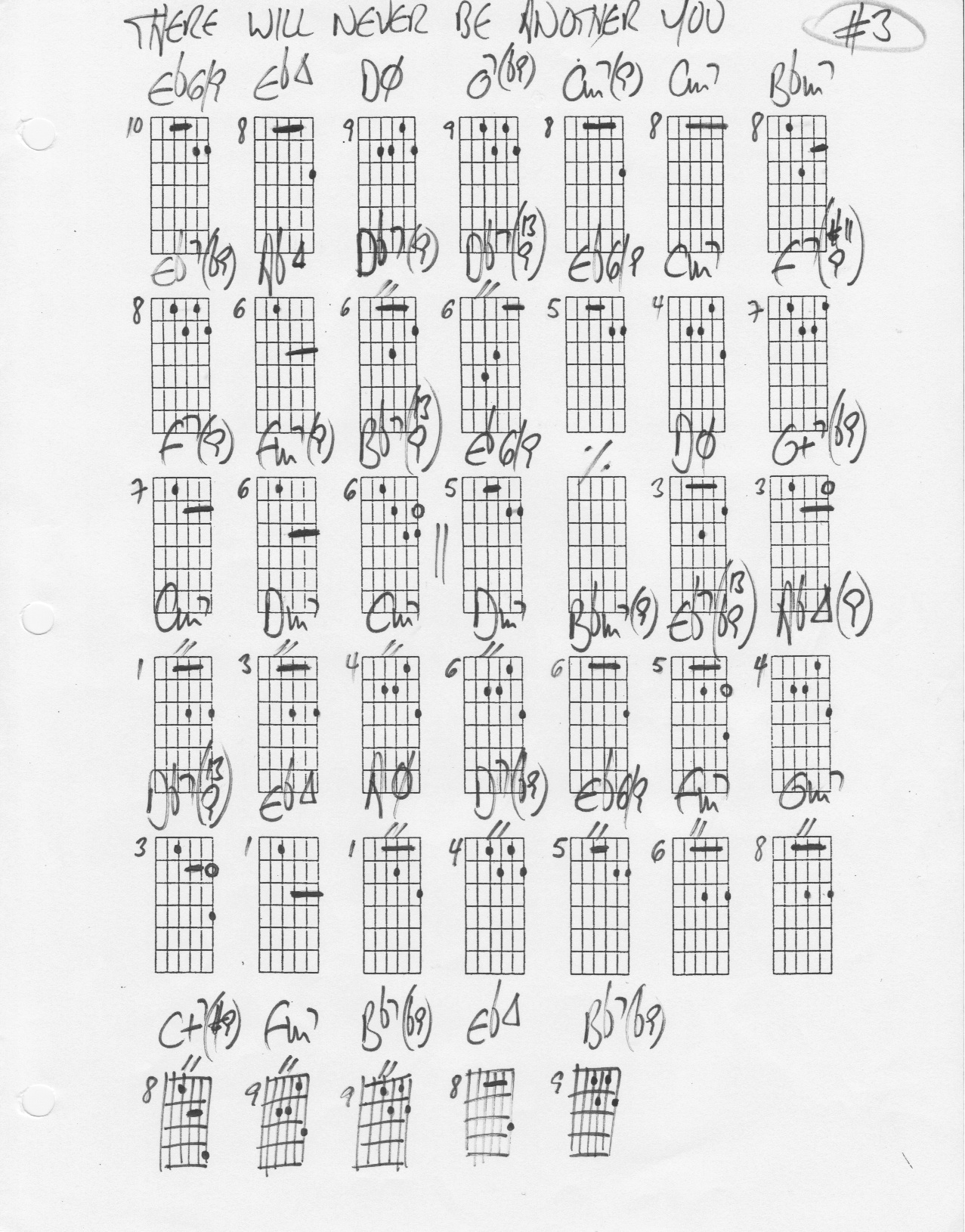
And finally, here's a comping study (for the whole tune) that illustrates some of the ideas discussed above.
Note that we only use the top 4 strings in this example, meaning that we can (should ?) play it with a bass player:
Download the PDF
Click here for explanations on Reading The Chord Diagram Studies.
CHORD STUDIES
Order 5 chord studies for "There Will Never Be Another You" written in diagram form (similar to the one presented on this page).
Those comping studies include different inversions, substitutions or variations. They use voicings with or without bass notes, and typically cover different string sets (low, high, etc.)
The studies come in pdf format and will be e-mailed directly to you within 24h.
Price: $5
CLICK HERE FOR OTHER CHORDS STUDIES AVAILABLE in pdf format
IF YOU LIKED THIS ARTICLE, PLEASE CONSIDER MAKING A SMALL DONATION :-)
YOU CAN CLICK THE PAYPAL BUTTON BELOW AND ENTER THE DESIRED AMOUNT FOR YOUR CONTRIBUTION-- THANK YOU !
I am available for private lessons on SKYPE or FACETIME for more information on this topic, or on anything related to Jazz Guitar, Improvisation or Music Theory.
Click here for details.
See all topics from the Various Thoughts page.
Go to the Home page.
All Content © Bruno Pelletier-Bacquaert 2005 - 2015
|





